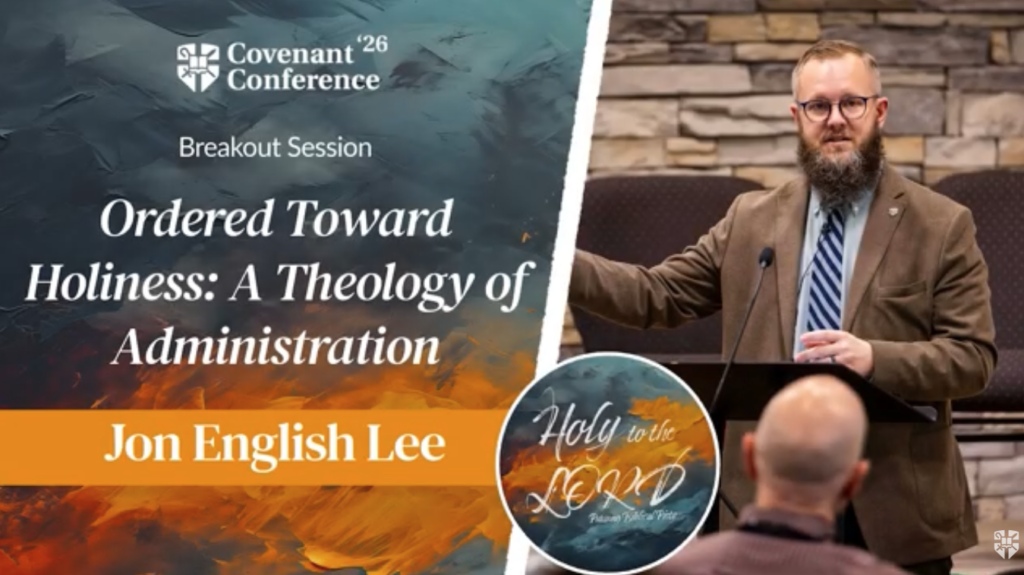
Good afternoon. For this break out session I want to do something different. This will not be a sermon, as such, but more of an extended analysis and application of some principles and patterns found in scripture.
But before we get to that, I want to ask you what you think of when I mention the word Administration. Admin, specifically, church admin.
Some people think of boring, mundane things like schedules and spreadsheets and policies and procedures. Pencils and staplers and calendars.
Within church leadership, people often think of the real work of ministry being the preaching and prayer and counseling, while administration is the necessary evil of being a pastor.
But I would suggest to you that such a view of admin is really truncated. It is too small a view.
Administration done well is actually a service of love to other people.
If you go to an airport and you don’t really have to think much about where to go, or where your gate is, or where the restrooms are, that’s because some administrator thought well about the architectural design, the traffic flow, the signage font and location, and all the other administrative details related to the use of that space.
Conversely, if you’ve ever been somewhere and you get frustrated because you can’t figure out where anything is, you can’t find the bathrooms, can’t read the signs, can’t find your gate, that’s probably because of a failure of administration.
Those same dynamics are found not only in airports, but in churches. And I want to think through some of these dynamics today in light of scripture, with this simple thesis:
Good administration promotes the holiness of God’s people, and poor administration tempts the people of God to be unholy. Good administration promotes the holiness of God’s people, and poor administration tempts the people of God to be unholy.
Before we get much further, I’ll define what I mean by administration. It’s related to a nexus of words in scripture with overlapping meaning: to direct, to oversee, to govern, to manage or rule. I want to sharpen it a little. Administration, biblically speaking, is: a gift of the spirit, that enables someone to love well by wisely anticipating needs. A gift of the spirit, that enables someone to love well by wisely anticipating needs.
A friend and former pastor of mine says that “Administration is not bossiness. It is structured, anticipatory love.” [citation: Ben Hedrick, “Displaying Christ through Administration,” talk given at an Immanuel Network Conference. Manuscript was shared via personal communication. ]
In its best expressions, godly administration is a gift of the Holy Spirit, wherein we see someone use their wisdom and imagination to anticipate ahead of time what needs might arise in a given setting, and then motivated by love they seek to meet those needs before they appear.
We will see this illustrated in various ways as we walk through this talk today. But first,
If you have your bibles, please turn to Exodus 18 AND Acts 6. Exodus 18 and Acts 6. I want to quickly read these two passages of scripture and draw out some principles of good leadership, good pastoral application of administration for the holiness of God’s people.
Exodus 18:13–26:
13 The next day Moses sat to judge the people, and the people stood around Moses from morning till evening. 14 When Moses’ father-in-law saw all that he was doing for the people, he said, “What is this that you are doing for the people? Why do you sit alone, and all the people stand around you from morning till evening?” 15 And Moses said to his father-in-law, “Because the people come to me to inquire of God; 16 when they have a dispute, they come to me and I decide between one person and another, and I make them know the statutes of God and his laws.” 17 Moses’ father-in-law said to him, “What you are doing is not good. 18 You and the people with you will certainly wear yourselves out, for the thing is too heavy for you. You are not able to do it alone. 19 Now obey my voice; I will give you advice, and God be with you! You shall represent the people before God and bring their cases to God, 20 and you shall warn them about the statutes and the laws, and make them know the way in which they must walk and what they must do. 21 Moreover, look for able men from all the people, men who fear God, who are trustworthy and hate a bribe, and place such men over the people as chiefs of thousands, of hundreds, of fifties, and of tens. 22 And let them judge the people at all times. Every great matter they shall bring to you, but any small matter they shall decide themselves. So it will be easier for you, and they will bear the burden with you. 23 If you do this, God will direct you, you will be able to endure, and all this people also will go to their place in peace.”24 So Moses listened to the voice of his father-in-law and did all that he had said. 25 Moses chose able men out of all Israel and made them heads over the people, chiefs of thousands, of hundreds, of fifties, and of tens. 26 And they judged the people at all times. Any hard case they brought to Moses, but any small matter they decided themselves.
Acts 6:1–7:
Now in these days when the disciples were increasing in number, a complaint by the Hellenists arose against the Hebrews because their widows were being neglected in the daily distribution. 2 And the twelve summoned the full number of the disciples and said, “It is not right that we should give up preaching the word of God to serve tables. 3 Therefore, brothers, pick out from among you seven men of good repute, full of the Spirit and of wisdom, whom we will appoint to this duty. 4 But we will devote ourselves to prayer and to the ministry of the word.” 5 And what they said pleased the whole gathering, and they chose Stephen, a man full of faith and of the Holy Spirit, and Philip, and Prochorus, and Nicanor, and Timon, and Parmenas, and Nicolaus, a proselyte of Antioch. 6 These they set before the apostles, and they prayed and laid their hands on them. 7 And the word of God continued to increase, and the number of the disciples multiplied greatly in Jerusalem, and a great many of the priests became obedient to the faith.
So, with these two passages in the back of our minds, I want to draw out some principles and observations related to the pastoral application of administration among God’s people. These principles aren’t only relevant to the church; you could adapt them to your home, or your business, or even to good administration of civil government. But I will be focusing on church administration.
First principle related to good administration: Good admin aids sustainability. Good admin aids sustainability. Or we can also say good admin aids organizational stability.
Back in Exodus 18 Jethro told Moses to delegate his responsibilities and draft more men into service. And one of the benefits of such delegation is found in verse 23, where Jethro says, “If you do this, God will direct you, [and] you will be able to endure.” You will be able to endure.
Good administrative leadership is concerned with structures that produce stability, that produce sustainable patterns and policies. Wise leaders aren’t simply looking at what needs to be done today, but they are also looking into the future. They aren’t short sighted, and they don’t set up things in such a way that will be problematic for tomorrow.
This principle is also confirmed when you feel the absence of it. If Good admin aids sustainability and sustainability in ministry, then the opposite is true too: bad administration makes things unstable and unsustainable.
Perhaps you have seen this in churches. A young pastor might come into a new church, and right out the gate he is preaching twice on Sundays, teaching Sunday school, leading prayer meeting Wednesday nights, leading small groups throughout the week, doing all the counseling, and printing all the bulletins for Sundays.
This kind of person usually equates productivity with fidelity, which means he pursues efficiency above all else. This mentality tempts a man to reduce ministry fruitfulness down to mere output, forgetting that faithfulness ought be our goal, not simply production.
And then, within three years, this man is no longer in ministry.
What happened? Well, in part, he failed to administrate well. He experienced burn out because he didn’t create a sustainable ministry structure.
That same pattern impacts churches too. Poor leaders can carelessly overburden their own congregants, leading to key lay leaders burning out because of unsustainable workloads or unrealistic timeframes.
Whatever the issue, when church leaders don’t administrate well, it often results in pastors that don’t stay long at that church, and when you have a revolving door of leadership, it tempts people to be unholy.
They can be tempted to be fearful of the future, unsure of what the church will be like from week to week or year to year.
They can be tempted to not submit to their biblical leaders like they are supposed to, because they don’t trust them to lead well.
They can be tempted to be frustrated with the leaders, annoyed by what they perceive to be a lack of leadership. Where there is no vision, the people cast off restraint, proverbs 29:18 says, and when a congregation feels there to be a lack of leadership, they will struggle. Where there is no guidance, a people falls (Proverbs 11:14).
A church’s leadership should concern itself with stability and sustainability. That’s why Paul told Timothy to pass on to other faithful men the things that he had been taught. Each generation has a duty to care for the stability of the church and the well-being of the next generation, which requires administrative attention.
Good admin promotes holiness by promoting stability and sustainability, and bad admin tempts toward unholiness by undermining stability.
Next, a second principle we see in scripture: Good administration promotes peace. Good administration promotes peace.
Again Jethro concludes his advice to Moses Exodus 18: “If you do this, God will direct you, you will be able to endure, and all this people also will go to their place in peace.” They will go to their place in peace.
Generally speaking, when you have good administrative leadership, it promotes peace. When Joseph ruled well in Egypt, there was peace in the kingdom. When Solomon ruled Israel well, there was peace with surrounding nations, and the people were happy.
When the queen of Sheeba came to visit Solomon, one of the things she praises is how Solomon’s subjects were satisfied under his reign. She said in 2 Chronicles 9: “Happy are your men! Happy are these your servants, who continually stand before you and hear your wisdom!” Even Solomon’s slaves were happy because of his wise leadership.
Furthermore, we can also prove this principle by observing the opposite. Poor admin undermines peace. We could go back to Acts 6, where we say an administrative problem producing a spiritual problem. The admin problem was that some of the widows were being neglected, and that administrative oversight was producing a spiritual problem.
It tempted people toward unrest, disunity, the opposite of peace.
Unwise leaders can tempt their people toward disunity and unrest in a variety of ways. For example, if church leaders are not appropriately transparent, their people will be tempted to not submit and support the leaders.
If leaders don’t have financial transparency, then the congregation will be hesitant to financial support.
If leaders don’t have proper transparency in matters of church discipline, then the people will be tempted not to support discipline decisions which can be quite emotionally painful.
If leaders don’t communicate well, then Satan can tempt the congregation to not trust the direction that the Pastors are heading.
Satan loves poor administrators in the church, because he often uses poor leadership to tempt the sheep to disdain the leaders that God has placed over them.
Good administrative leadership promotes congregational peace, and poor administration undermines peace.
Third, a third principle we see in scripture, is that godly administration is word-centered. Godly administration is word centered.
Within Jethro’s advice in Exodus 18 we read that Moses was commanded to “warn [the people] about the statutes and the laws, and make them know the way in which they must walk and what they must do.”
Godly pastoral leadership more generally is concerned with what God has revealed in his law, and concerned with INSTRUCTING the people of God about that revelation. But I’m not precisely talking about the instruction aspect, however crucial that is. I’m more talking about how godly ADMINISTRATION is concerned with ADMINISTRATING according to God’s word.
This means viewing the revelation of God as the boundary and center of our administrative philosophy. The bible contains the godly administrator’s marching orders and ethos. What do I mean by that.
This looks like choosing leaders in the church based upon the BIBLICAL qualifications, rather than worldly credentials or accolades. Prioritizing godly character, rather than someone’s capacity to financially give, or the size of their social media presence, or some other worldly metric of success.
Word-centered admin also trusts the Lord enough to delegate. It takes faith to give up leadership to someone else, but that’s what a godly leader must do. I must be humble enough to know where I am weak, and trust the Lord enough to give others some delegated authority to oversee things in the church, just like Jethro told Moses to do.
I could give a whole talk on this point alone, but the main idea for now is that good church admin is not ultimately led by the prevailing winds of the best practices among fortune 500 companies, however much wisdom may be found in such things.
We don’t automatically adopt the administrative principles of the world to run the church. We have a higher calling, and we have God’s revelation as the touchstone of our administration.
And leaders are not free to do whatever they like. We could further illustrate this principle by stating it’s opposite: Godly admin is word-centered, but ungodly admin is not centered on the word.
Ungodly admin may be centered on the structures and practices of the Harvard business review.
Or even worse, ungodly leadership can be driven by the capriciousness of a prideful man or group. Sheep can get frustrated having to follow a man who simply does whatever he pleases, who acts like he is the final authority, and it is his way or the highway. [ For more on the biblical limits of pastoral authority, see: Steven Martin, Biblical Shepherding of God’s Sheep: The Use and Abuse of Authority by Church Officers (Day One Publications, 2010).]
Rather than feeding and leading sheep according to God’s word, this kind of poor leader chooses to lead by his own word. What he says, goes, and if you question him, then you get in trouble, because this man views himself as the highest authority, even above the word of God, even though he may never be so crass as to admit that.
He is the Lord of the conscience. He tells people how to dress, how to act, where to go and what to do.
Such administrative over-reach is contrary to the word of God, no matter how many Bible verses this shepherd may try to cite in defense of his domineering leadership.
But, such over-bearing leadership isn’t the only way to fail to be word-centric. The opposite is true too. Some leaders tempt their congregations to be unholy, not by domineering, but by neglect.
Neglecting your role as an administrative leader can be just as much of a stumbling block for your sheep as over-stepping the bounds of your biblical authority.
Sometimes even in the reformed tradition we see this problem: men think that their job is to just preach really well, and then the rest is just someone else’s problem.
Or, a neglectful shepherd may be indifferent to the needs of the sheep, failing to provide counsel when it is needed, failing to address clearly perceived problems in the congregation, avoiding potentially-unpleasant conversations, or failing to listen to the concerns of the flock.
Such a neglectful pastor is derelict in his duties, duties which are clearly spelled out in the pastoral epistles, so I won’t spell them out now.
The point is, failing to be word-centered can look like domineering overreach, or it can look like indifferent neglect, and both of those failures of administrative leadership tempt the congregation toward unholy responses, and tempt Satan to attack the unity of the congregation.
Good administration is focused on the word of God, and seeks to lead according to it, rather than picking and choosing the parts of it that fit his preferences and ambitions.
And thus fits nicely with my final principle: Godly administration needs godly administrators. Godly admin needs godly admins.
Jethro told Moses in Exodus 18:21 to “Look for able men from all the people, men who fear God, who are trustworthy and hate a bribe, and place such men over the people as chiefs of thousands, of hundreds, of fifties, and of tens.”
The Apostles told the saints in Acts 6, “Therefore, brothers, pick out from among you seven men of good repute, full of the Spirit and of wisdom, whom we will appoint to this duty. ”
Godly administrative leadership in the church starts with godly men. Holy admin needs holy admins.
And why is that the case? The answer may seem obvious, but let me tease it out a little bit.
If a leader is not humble, then he will be slow to ask for help when he needs it. He will be slow to seek out advice, slow to delegate, slow to consider the needs and interests of others, and therefore slow to anticipate those needs before they arrive. In short, a proud man makes for a poor administrator.
Godly administration needs godly administrators, and the inverse is true as well: Poor administration can let unholy leaders rule.
Sometimes people will be tempted to put up with some unholiness in a leader as long as they get things done. That’s true in politics and that’s sadly true in the church. But that can’t be the case.
Unholiness must not be tolerated among the churches leadership; that’s why Paul’s qualifications for church officers in 1 Timothy 3 is almost exclusively focused on character traits, not credentials, not achievements, not worldly acclaim, but character.
Godly administrators are given by the Holy Spirit as a gift to the church (1 Corinthians 12:28, or Romans 12:8). The spiritual gift of Administration is just as much a precious gift to the church as the other spiritual gifts. Teaching might be more prominent, but the gift of Administration is just as much the work of the Holy Spirit.
They are meant to be a part of the body that helps the church grow up into maturity, and one gift can’t say to the other that I don’t need you, as Paul says in 1 Corinthians 12. We need all the parts and gifts to have a mature and healthy body.
Gifted admins enable other people with different spiritual gifts to find their proper place of service, promoting the congregation’s harmony and mutual edification.
And when you plug unholy leaders into these slots, you tempt the whole body toward disfunction and disunity. You’ll end up with tribalism, or with favoritism, or with personalities that dominate, rather than serve. You invite Satan to attack, and tempt the sheep to behave in unholy ways.
Godly administration needs godly administrators.
Now, I want to close by asking what any of this has to do with Jesus. Some of you might be tempted to despair because you see that you have not led with godliness. Perhaps you’re weak in administration and you’ve chosen to simply neglect it and hope someone else handles it. You get annoyed about having to go to budget committee meetings, or handle things like policy questions, or nursery schedules. You just want to teach the word and love people; so you ignore the rest, hoping it will just resolve itself.
Perhaps you’re the opposite, you’re very interested in systems and workflows and policies and spreadsheets. That kind of leader can be tempted too, tempted to believe that if he just gets the right system in place, finds the right life hack, crafts the perfect policy, that he will rid his ministry of all inefficiencies and all headaches.
If I just put into place the perfect set of bylaws, then our church will be guaranteed to run smoothly and without disunity. I can administrate myself into a situation where I can anticipate any potential problem before it arises and therefore won’t need to trust the Lord to protect the church anymore.
Both of those pastors need to repent and remember the gospel. Christ is the only perfect administrator, and he has loved you in the gospel well by perfectly anticipating your needs and providing for you the exact things that you need. In short, Jesus died for poor administrators. He died for lousy leaders, and proud pastors.
He knew that you would be tempted and would fall in the ways that you do. And he went to the cross for you anyway. He perfectly fulfilled the law in your place, succeeding in all the ways that you are weak.
He’s the Great high priest, interceding on your behalf at this very moment, anticipating your future needs and pleading on your behalf for your needs to be met. He’s weaving together a million little details that will all result in your future preservation and protection.
And even now, he perfectly administrates HIS bride, the church, by sending his Holy Spirit to give the gifts that each congregation needs. With perfect divine omniscience, He knows the personalities and the problems, He knows the strengths and weaknesses, he knows the competencies and the incompetencies present, and he gives to his flock what is needful for her, that she might grow in faith and love.
The thorns and thistles will remain until Jesus returns, and those thorns and thistles will be there, even in the best run church or home. Even if you could administrate with perfect precision, you still can’t rid the church of its sin in this age.
But Christ will. He will perfectly wash her with the water of the word. She will one day be spotless and without blemish. But that day is not yet here.
For now, God permits administrative headaches, he allows inefficiencies and scheduling oversights, for our good, and for our holiness, and for our church’s good and for her holiness. Paul said in 1 Thessalonians 4:3, “For this is the will of God [for you], your sanctification.”
Sanctification, holiness, is the will of God for both sheep and shepherds, for both pastors and our people. [NB: On this topic I was helped by my friend’s paper: Matt O’Reilly, “To What End Our Labor? The Telos of the Pastor-Theologian,” originally presented at the October 20–22, 2025 Conference of the Center for Pastor Theologians, video available here: https://www.pastortheologians.com/good-shepherds-2025-pastor-theologians-conference (accessed 3/10/2026). Manuscript was shared in personal communication.]
May we strive to lead well, to administrate well, in love, and by the Spirit’s help, so that our people may be holier because of it, and not despite our administration. Amen.